Why Air Freight Is Your Best Bet When Ocean Schedules Are Disrupted

Posted - April 28, 2026
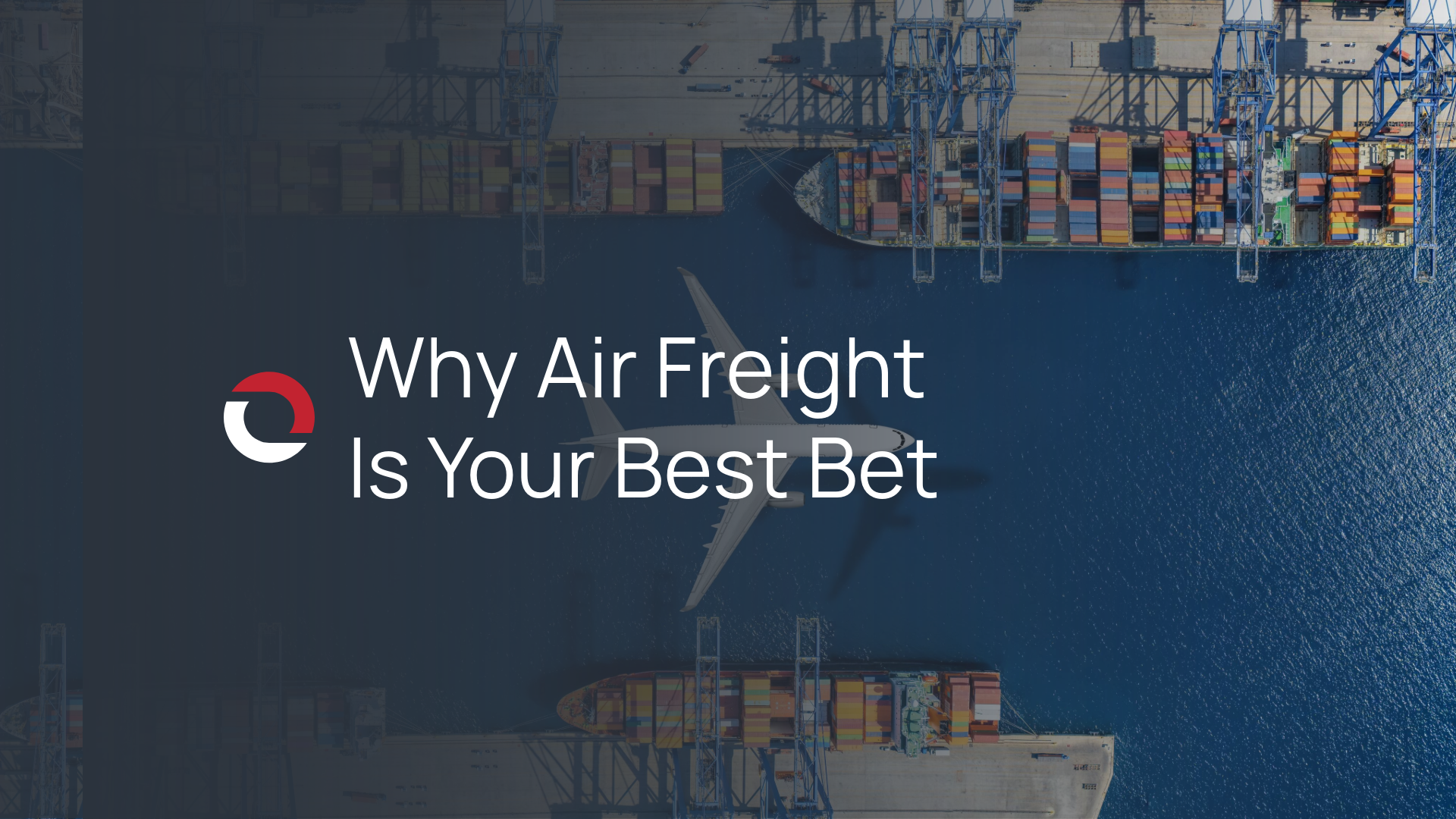
Aerial top view of a cargo plane flying above container freight port with docked ships and loading and unloading by cranes and trucks showing ocean vs. air freight

When shippers call their air freight providers, sometimes it’s to pivot the mode of transport. When a port is congested and the window for their peak season is closing fast, they call air freight. Or because what was supposed to be a 30-day ocean transit just turned into 55 days, and the shelves can’t wait. Air freight is often treated as the backup plan, and the option you reach for when the original plan has already fallen apart. 

But for many shippers, that reactive approach is costing more than it saves. The companies managing supply chain disruption well right now aren’t just calling their air freight provider in a panic. They’ve built air into their strategy before they need it. And that changes how much it costs, how smoothly it runs, and how much leverage they have when something does go sideways. 

The Reliability Gap: Ocean vs. Air in 2026 

Ocean freight has always been the workhorse of global trade because it moves the most volume at the lowest cost per unit, and for the right cargo, nothing beats it. But the past few years have made one thing very clear: ocean schedules are vulnerable in ways that can have serious downstream consequences. 

Port congestion, blank sailings, vessel diversions, labor actions, canal disruptions; the list of things that can add weeks to an ocean shipment has gotten longer, not shorter. When those delays hit during a product launch window, a retail peak season, or a just-in-time manufacturing cycle, the cost of “saving money on freight” can quickly exceed what air would have cost in the first place. 

Air freight moves on a different timeline entirely. Commercial airlines run on rigid, predictable schedules. Flights depart daily on most major international lanes, and transit times are measured in days, not weeks. 

And when you work with a provider who has real airline relationships and volume leverage, you have actual options, not just whatever spot capacity is left on the market when you need it most. 

That reliability doesn’t mean air is right for every shipment, but it means it’s worth understanding when it makes sense, so you’re not making that decision under pressure. 

Ocean vs. Air: When Air Freight Makes Financial Sense 

The instinct to avoid air freight because of cost is understandable: per-kilogram rates are genuinely higher than ocean. But “higher rate” and “more expensive overall” aren’t the same thing. 

Here’s how the math actually works: 

  • Carrying costs

Every day your inventory is in transit on an ocean vessel, you’re carrying the cost of that working capital. For high-value goods (electronics, semiconductors, luxury products, pharmaceuticals) a 30-day ocean transit ties up significant cash. Air freight’s shorter transit time means faster inventory turns and lower carrying costs, which can offset a meaningful portion of the freight premium. 

  • Stockout risk

If a delayed ocean shipment means empty shelves, a missed launch window, or a production line that goes down, the lost revenue rarely shows up in the freight budget, but it’s real. For cargo categories like AOG (aircraft on ground) parts or line-down manufacturing components, the cost of delay can be enormous. A few extra dollars per kilogram on freight is irrelevant against that exposure. 

  • Density  

Air cargo is priced on whichever is greater: actual weight or volumetric weight. Dense, compact cargo rates significantly better than light, bulky cargo. If your product is heavy relative to its size, you’re often in a better pricing position for air than you might expect. 

  • Reactive air  

Spot rates on last-minute bookings are significantly higher than contracted or planned rates, and your carrier options narrow fast. Rate validity in air freight is often less than seven days, and the market is volatile; capacity tied to passenger demand shifts with seasons and weather events. The shippers who plan for air in advance, with contracted lanes, known carriers, and established relationships, consistently pay less than those who scramble. 

  • The right cargo 

Not everything benefits equally. The products that make the most sense: high-tech components requiring secure chain of custody, perishables with shelf-life constraints, aviation and automotive parts under AOG or line-down pressure, e-commerce requiring volume and reliability, inventory for product launches, and high-value items where reduced handling protects the asset. 

Understanding Your Air Freight Options 

One of the things that trips shippers up is assuming “air freight” is a single product. It’s not. There’s a full spectrum of service levels, each with its own cost, speed, and risk profile, and matching your shipment to the right level is where a lot of money gets left on the table. Here’s what you need to think about when considering ocean vs. air freight.

Here’s how the main options stack up: 

  • Hand Carry / On Board Courier (OBC)   

The fastest and most secure option. A dedicated courier travels with the shipment from pickup to delivery, with the cargo moving as checked or carry-on baggage.  

  • Next Flight Out (NFO) / Aircraft on Ground (AOG)  

When hours matter. Cargo moves back-to-back (one HAWB on one MAWB, no consolidation with other freight) on the next available flight, with a dedicated truck dispatched directly to the airport. 

  • Charter  

When you need to control the entire airplane. Charters give you full control over origin, destination, departure time, and aircraft type. They’re the most flexible option for oversized or out-of-gauge cargo, dangerous goods that can’t move on passenger aircraft, or high-volume surges that would require too many commercial flights to manage.  

  • Express (1–3 days airport to airport)  

Moves back-to-back like NFO but without the ground expediting premium. Very reliable, proactive customer service, with some constraints on commodities and size depending on routing.  

  • Standard (3–5 days airport to airport)  

The workhorse of air freight. May be held or rerouted for cost savings within your transit time window. Pricing is more accessible, rebooking is possible without a fee, and it works for a wide range of commodities and shipment sizes. 

Omni’s Air Freight Network 

Omni’s international air freight operation spans 50 offices in 19 countries with agent partners across 75 countries. The network is built around the lanes that actually move: the top five by volume are US–Germany, China–US, Hong Kong–US, Vietnam–US, and Sri Lanka–US, reflecting a heavy concentration in high-tech and consumer goods trade. 

  • Trade compliance built in. 

For international air freight, compliance isn’t an afterthought — it’s part of the workflow. Omni’s team handles export AES filing, known shipper validation (required for cargo on passenger aircraft), HTS/HS code review, ECCN screening, and customs brokerage. On the export side: USPPI identification, license determination, AES filing, and SLI documentation. On the import side: IOR identification, HTS classification, customs broker coordination, and EORI for EU shipments. 

  • 24/7 support and visibility.  

Our dedicated account management teams are always on the job, keeping a close eye on every shipment. We offer a customer visibility portal, complete with tracking and reporting capabilities. When it comes to AOG and time-sensitive shipments, we don’t just communicate; we do so proactively, as a matter of course. 

Ready to Talk Through Your Ocean vs. Air Freight Options? 

Whether you’re dealing with an immediate need or building a more resilient freight strategy for the rest of the year, Omni’s air freight team is ready with the carrier relationships, the gateway infrastructure, and the around-the-clock support to make it work on your lanes. 

Request an air freight rate quote and find out what your options actually look like. 

Contact Us – Logistics Experts

FAQ

Ocean vs air freight: frequently asked questions

What supply chain and logistics teams ask most about when to use air freight, how the cost math actually works, the service levels available, and how to plan air into a strategy instead of reaching for it in a panic.

Ocean vs air freight: when does air freight make more sense?

Ocean freight moves the most volume at the lowest cost per unit and is hard to beat for the right cargo, but ocean schedules have grown vulnerable to port congestion, blank sailings, vessel diversions, labor actions, and canal disruptions that can add weeks. Air freight runs on rigid, predictable schedules with daily departures on most major lanes and transit measured in days, not weeks. Air makes more sense when a delay would hit a product launch, a retail peak, or a just-in-time cycle, so it is worth deciding when to use it before you are under pressure rather than reaching for it only after the original plan falls apart.

Is air freight always more expensive than ocean freight?

No. Per-kilogram air rates are genuinely higher than ocean, but a higher rate and a higher total cost are not the same thing. Every day inventory sits on an ocean vessel ties up working capital, so air's shorter transit means faster inventory turns and lower carrying costs that offset part of the premium. And if a delayed ocean shipment causes empty shelves, a missed launch, or a line-down event, the lost revenue rarely shows up in the freight budget but can dwarf a few extra dollars per kilogram.

What is volumetric (dimensional) weight, and how does it affect air freight cost?

Air cargo is priced on whichever is greater: actual weight or volumetric (dimensional) weight, which is based on the space the shipment occupies. Dense, compact cargo rates significantly better than light, bulky cargo. So if your product is heavy relative to its size, you may be in a better pricing position for air than you would expect, while light and bulky freight costs more than its scale weight alone suggests.

What types of cargo are best suited for air freight?

Not everything benefits equally from air. The products that make the most sense include high-tech components that need secure chain of custody, perishables with shelf-life constraints, aviation and automotive parts under AOG or line-down pressure, e-commerce that needs volume and reliability, inventory for product launches, and high-value items where reduced handling protects the asset. The common thread is that the cost of delay, or of damage, is high relative to the freight premium.

Why do air freight rates change so fast, and how do you get better ones?

Air freight rates move quickly. Rate validity is often less than seven days, capacity is tied to passenger demand and shifts with seasons and weather, and spot rates on last-minute bookings run significantly higher while carrier options narrow fast. The shippers who plan air in advance, with contracted lanes, known carriers, and established relationships, consistently pay less than those who scramble after a plan has already fallen apart.

How Omni helpsWith real airline relationships and volume leverage, Omni gives shippers actual planned options and contracted lanes rather than whatever spot capacity is left on the market when they need it most.

What are the different air freight service levels?

Air freight is not a single product. The main service levels, fastest to most economical, are: Hand Carry or On Board Courier (OBC), where a dedicated courier travels with the cargo as checked or carry-on baggage; Next Flight Out (NFO) or AOG, moving back-to-back on the next available flight with a truck dispatched directly to the airport; Charter, giving full control of the aircraft for oversized, dangerous-goods, or high-volume needs; Express, a reliable one to three day airport-to-airport service without the ground-expediting premium; and Standard, the three to five day workhorse with more accessible pricing and fee-free rebooking. Matching the shipment to the right level is where a lot of money is saved or lost.

How Omni helpsOmni offers the full spectrum, from OBC and NFO/AOG through charter, express, and standard, so each shipment can be matched to the right balance of cost, speed, and risk.

What is the difference between express and standard air freight?

Express moves back-to-back like NFO but without the ground-expediting premium: a reliable one to three day airport-to-airport service with proactive customer service and some commodity and size constraints depending on routing. Standard is the three to five day workhorse, which may be held or rerouted for cost savings within your transit window, offers more accessible pricing and fee-free rebooking, and handles a wide range of commodities and shipment sizes. Express buys speed and consistency; standard buys flexibility and lower cost.

When should you charter an aircraft for freight?

Charter makes sense when you need to control the entire aircraft, with full control over origin, destination, departure time, and aircraft type. It is the most flexible option for oversized or out-of-gauge cargo, dangerous goods that cannot move on passenger aircraft, or high-volume surges that would otherwise require too many commercial flights to manage. It costs more, but for those situations it is often the only option that works.

How does trade compliance work for international air freight?

For international air freight, compliance is part of the workflow rather than an afterthought. On the export side that includes USPPI identification, license determination, AES filing, known shipper validation (required for cargo on passenger aircraft), HTS/HS review, ECCN screening, and SLI documentation. On the import side it includes IOR identification, HTS classification, customs broker coordination, and EORI for EU shipments. Getting this right up front is what keeps time-sensitive shipments from stalling at the border.

How Omni helpsOmni builds trade compliance into the workflow, handling AES filing, known shipper validation, HTS/HS and ECCN screening, customs brokerage, and EU EORI, so compliance doesn’t become the delay.

What should you look for in an air freight provider?

Look for a provider with real airline relationships and volume leverage, so you get planned options instead of leftover spot capacity, gateway infrastructure on the lanes you actually ship, built-in trade compliance, and around-the-clock support with real shipment visibility. The goal is a partner who can turn air from a panic button into a planned part of your freight strategy.

How Omni helpsOmni’s international air network spans 50 offices in 19 countries with agent partners across 75 countries, concentrated on high-volume lanes like China–US, Hong Kong–US, and Vietnam–US, backed by 24/7 account management and a customer visibility portal.

Facing an immediate need, or building a more resilient freight strategy for your lanes?

Request an air freight rate quote

Mach1 现在是 Omni Logistics

Mach 1 现在是 Omni Logistics!我们期待着作为 Omni 团队的一员,提供广泛的解决方案和能力。您现在将跳转到 Omni Logistics 网站。